
June is identified as Pride month to commemorate the 1969 uprising at New York City’s Stonewall Inn, the historic protest against discrimination and violence against the LGBTQ community. Tired of being beaten and mistreated, they came together to begin the demonstrations that gave birth to the Pride movement. We have come a long way in the past 50 years, but the recent proposal to have a Straight Pride in Boston reminds us of how much further we still have to go. The organizers of this event claim that “straight people are an oppressed majority” and need to fight for the right “to express pride in themselves without judgement and hate”. These folks could just be going for irony, but for the sake of argument, I’m going to examine this statement.
I identify as straight and I’m having a really hard time remembering the last time I had to come out to anyone. It might be because I have never had to. I have never had to worry about how my orientation might make a friend, my family, or my colleagues feel about me or think about me. I’ve never had to sit someone down and say, “I have something to tell you” and then worry that the words I am about to utter next will change everything between us. I am also fairly certain that no other straight person has had to come out, either. Why? Because every day is Straight Pride day. Straight couples hold hands, hug, or even kiss in public daily without being accused of flaunting their sexuality, without worrying if they will be verbally or physically assaulted. A wedding between a man and woman is celebrated without question and they can expect to be congratulated by onlookers and not held in contempt. And when they travel abroad for their honeymoon, they won’t have to worry if their marriage will be recognized. We straight folk enjoy heterosexual privilege that allows us to live and love freely without even thinking anything about it. Not so for my LGBTQ friends.
Many times I have been on the other side of “I have something to tell you” and it is always an intimate and beautiful experience. Sometimes what follows the phrase is something absolutely joyous – I’m in love, I’m getting married, we’re expecting; and sometimes it is something that requires sympathy and support – I have cancer, I’m getting a divorced, I’ve had a miscarriage. Whether happy or sad, the news that is being shared is an indication of love and trust. I am being let into the inner world of another and it is a great honour. It is especially so when what follows “I have something to tell you” is an expression of sexual orientation or gender identity. It is why I prefer the term “letting in” instead of “coming out”. Karamo Brown from “Queer Eye For the Straight Guy” once explained that coming out gives power to the other person to accept or deny while letting people in allows one to keep the power.
 On the occasions that friends have let me into their LGBTQ world, I will admit to feeling emotional and conflicted. Emotional because they have shared this beautiful part of their identity with me, and conflicted because in their eyes is that flicker of worry and it pains me that I am part of the culture that creates that concern. It’s not right that the concern is there. It’s not right that we even have to have this conversation. It’s not right that even now, here in the Lower Mainland of Vancouver, hanging a rainbow flag to celebrate Pride month is met with opposition and hate.
So, to my LGBTQ friends and family, I am ever so grateful and honoured that you trusted me enough to let me into your inner world. And I promise you that I will continue to do what I can to make this a world where no one will ever have to come out again. Love is love, and love will always win. Happy Pride.


 The desire to control or abolish emotions is a theme that I have also seen in my private practice. In the past year, I have had many clients come to see me wanting to change the way they feel. You might be thinking that seems reasonable – you’re a counsellor, isn’t that what you do? Well yes, absolutely – I have been trained in Cognitive Behavioural Therapy to help client understand the relationship between their thoughts, feelings, and behaviour. The theory suggests that if we can identify and change the unhealthy thoughts, it can help with unhelpful feelings like anxiety. However, sometimes clients who come to see me have experienced an extremely upsetting event – a loved one dying, a sudden job loss, a devastating break-up. Some are therapy veterans and when asked what they are hoping counselling will help them with, they often say they want me to help them stop the emotions – they’d had therapy before and found it helpful to change the way they feel, could I help them with strategies that will stop the pain? Sadly, the answer is no. When something profoundly heart-breaking has just happened, it makes sense that we fall apart, that we cry, that we feel like our whole world has just collapsed. I can’t take away the pain, but I can help them process the thoughts and feelings that accompany an overwhelming loss. And I can also hold the space for them to cry, because if you can’t cry when someone you love has died, when can you? It seems to me our society has a bias towards happiness – that emotions other than joy are wrong, or that we are somehow doing something wrong and that’s why we are unhappy. I don’t think I’m the only one who recognizes this. The Disney movie
 Homework. There were some very strong words about the type and amount of homework they were assigned. They thought it was reasonable that there should be some homework, but as Lacey said, “I spent 6 hours of scheduled time in school already – it is unfair when school has to become your entire life!” Sometimes it seemed that the only purpose was to make them work harder and longer, not because they needed practice or to understand better. However, when it did make sense, they had no problem with it. Daniel spoke about one math teacher that was flexible with homework – the practice questions were suggested but optional if students felt like they had a good grasp of the concepts. This approach was very much appreciated and was meaningful to him, but it was a not a common practice. Instead the students spoke about feeling the pressure keep up, falling behind, and then being told to try harder. The homework piled up, seemed irrelevant, and got in the way of their passion for learning. They said it was demoralizing.

 You snap your head to attention and sit up straight, only to feel your body relax and the weight of your eyelids betray you over and over again. As you dig your nails into your palm, pinch your arms, and stab yourself with your pen to stay awake, you tell yourself, yet again, that you have got to go to bed earlier and get more sleep.
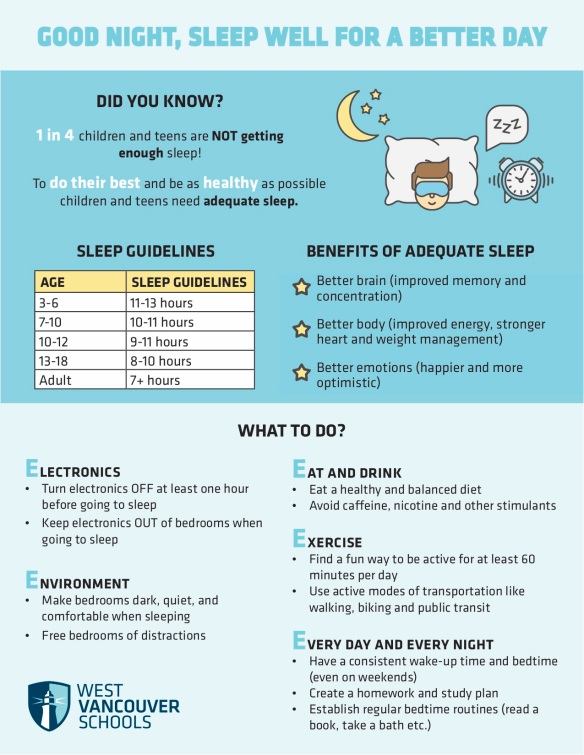 Each day will focus on one sleep tip to encourage a change for better sleep (see the details
  week and see how it changes your ability to sleep. If you just have to finish that assignment or report on your device, wear orange tinted glasses that filter out the blue light. Another small change that all individuals and families can make is to create a charging station away from the bedroom. I have been doing this for 6 months and the improvement in my sleep quality has been undeniable. I went back to using an old school clock radio for my alarm, and it has been amazing. Dr. Kimberly Schonert-Reichl and Dr. Mark Lysyshyn will be giving us more information and suggestions in the March 12th DPAC event
  me, for others, and right now. However, it can often be frustrating that change happens slower than I’d like. Sometimes it seems that the world is a cold and difficult place with
  called smartphones that connect us in ways unimaginable (if you don’t think this is such a big deal, watch this
 had heard people rave about this appliance before, but only bought it because it was a good deal on Amazon Prime day. OMG, it is the appliance I didn’t know I needed! What does it do, you ask? What doesn’t it do? It sautés, it slow cooks, it pressure cooks, it makes yoghurt, and most importantly, it saves time. After putting dinner in the Instant Pot, I will often do a workout while it’s cooking. The Instant Pot has revolutionized the way I cook and what I cook – I use it 2 to 3 times per week and make things I would normally never even attempt (think restaurant quality cheesecake and dulce de leche). I think I have convinced at least a dozen or so people in the district to get one and jump on the Instant Pot bandwagon. It’s worth getting it just for the cheesecake alone!
 As Chris Kennedy pointed out in his recent blog post (
 However, the structure of school itself isn’t designed for everyone. Schools were designed to meet what might be considered the “normal” needs of most of the population. If we consider a
 While we are rethinking special education, let’s rethink alternate education too.
  Recently, Stefan and Inglewood student, Teagan Hartwick, presented to our District Parent Advisory Committee. Teagan explained that the students at Inglewood are regular kids – they just need a different environment. She talked about how it didn’t work for her in the big school; she wasn’t attending and wanted to drop out. But being at Inglewood is different. She called Inglewood “home” and talked about working so hard that she could have graduated a year early. In fact, she has now applied to university. And while she talked about how she used to be failing in the other setting, I think she got that part wrong. School was failing Teagan. And unfortunately, despite the different options, technology, and new programs, we still aren’t reaching every child.
 The Summary of the Final Report of the TRC states: “No Canadian can take pride in this country’s treatment of Aboriginal peoples, and, for that reason, all Canadians have a critical role to play in advancing reconciliation in ways that honour and revitalize the nation-to-nation Treaty relationship (p. 183).”


